SOLAR SUN THAI · SOLAR GUIDES · CONTACT US
Solar + Battery — Store Sunshine for When You Need It
Solar panels produce electricity during daylight hours, while your home or business may need energy later. A battery can store some of the energy available during the day for use at another time. This can be useful when your needs and the solar production pattern do not line up, but the value depends on the property, the equipment, and the way the system is set up.
SolarSunThai can help you discuss solar and battery options for a property in Thailand. Start with the job you want the battery to do: use more of your own solar energy, support certain loads during a power cut, or compare both goals. Contact SolarSunThai for a solar and battery assessment based on your actual use.
Choose the job before choosing the battery
A battery should solve a clear problem. If your main aim is to use solar energy in the evening, the assessment needs to compare daytime surplus with evening demand. If your main aim is support during a power cut, the assessment needs to identify the equipment you want to keep running and for how long. Those two aims can lead to different settings and different equipment choices.
Write a simple priority list before discussing capacity. You might place a refrigerator, a few lights, internet equipment, or a small work area above other loads. Another household may care most about using stored energy after work. A business may have different priorities again. Explain the routine you want to support, then ask for a design that shows how each important need would be handled.
Understand the difference between kW and kWh
Battery discussions usually involve two different numbers. Kilowatts, written as kW, describe power: how much electrical demand the system can supply at a moment. Kilowatt-hours, written as kWh, describe energy: how much can be stored or delivered over time. Both matter. A battery may hold enough energy for a task while the inverter or battery power limit prevents it from supplying all the appliances together.
Ask about usable capacity as well as the capacity printed in a product name. The usable amount may differ from the total rated amount because of operating limits, reserve settings, and the system design. Real running time also depends on conversion losses and changing loads. A useful proposal explains these limits in ordinary language so that you understand what the system can support in your own building.
Look at when energy is available to store
A solar battery needs energy to charge. If your property already uses almost all its solar production during the day, there may be less surplus available than you expect. If the property is quieter during daylight hours, more energy may be available for storage. The assessment should consider your solar production pattern and your consumption pattern together, rather than starting with a battery size alone.
Think about weekday and weekend routines too. A home may be empty during working hours but busy on weekends. A shop may have regular closing days. These patterns change how often a battery can charge and discharge usefully. Recent bills help establish overall demand, while monitoring information, where available, can provide a closer view of timing. Tell the assessor about any planned changes to these routines.
Make evening use a realistic calculation
Evening demand can include cooking, cooling, hot water, lights, and entertainment equipment. These loads vary greatly in power and operating time. It is more helpful to list your important appliances and typical hours of use than to say you want the battery to run the house. A short period of high demand can matter as much as several hours of small loads when selecting equipment.
As a simple illustration only, a steady 0.5 kW load running for four hours uses 2 kWh of energy before system losses and reserve needs are considered. Real appliances may cycle on and off or draw more power when starting. This example is not a battery recommendation or a runtime promise. A practical design needs to consider the combined loads, available power, usable energy, and the way your property operates.
Make the next step about your property.
Share your location, electricity use and main questions with SolarSunThai. Use our contact page to begin a practical conversation.
Check exactly what backup would include
A battery does not automatically provide backup power when the electricity grid fails. Backup requires a compatible system design, appropriate controls, safe isolation from the grid, and a suitable arrangement for the circuits being supported. Some systems are designed mainly to shift energy use and may not provide the backup function you expect. Ask for this point to be made clear before choosing equipment.
If backup is a goal, identify selected circuits and ask how they would behave during an outage. Confirm power limits, expected changeover behaviour, reserve settings, and what happens when the battery is low. Large cooling loads, pumps, and other demanding equipment may need particular attention. Whole-property backup should never be assumed from the presence of a battery. Discuss your essential loads with SolarSunThai before deciding on a backup plan.
Check compatibility with your solar equipment
Adding a battery to an existing solar system can involve more than connecting a new box. The current inverter, electrical arrangement, monitoring equipment, and intended battery need to work together. Some properties may need additional equipment or a different design. Share the make, model, and installation details of existing equipment where you have them, along with any available manuals or original proposal.
For a new system, ask how the panels, inverter, battery, and monitoring will operate as one package. If you plan to add storage later, ask what is supported now and what would need to change at that time. Future compatibility should be confirmed against actual equipment choices. A general statement that a system is ready for a battery is less useful than a clear explanation of the supported arrangement.
Plan a suitable place for the equipment
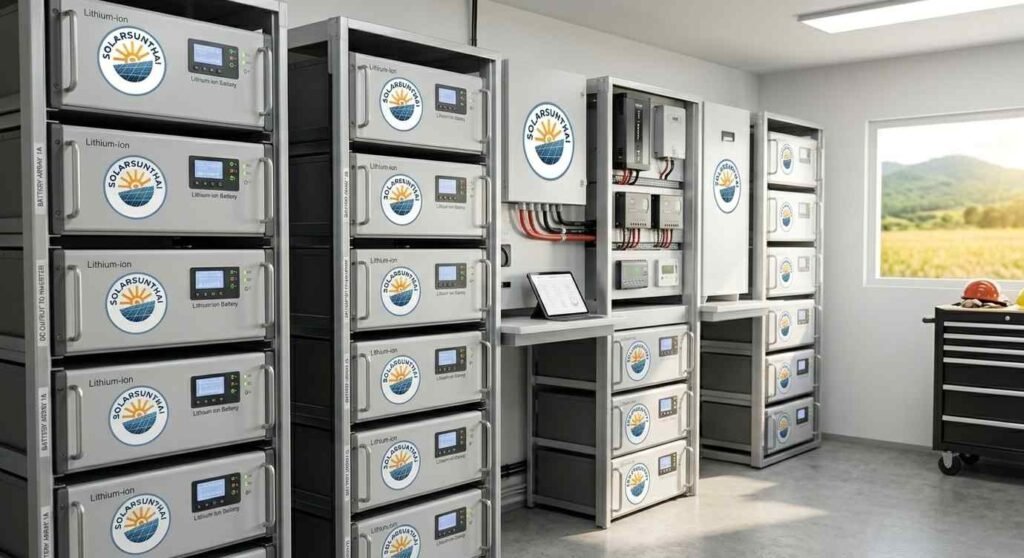
Battery equipment needs a location that suits the selected product and its installation requirements. Access, heat, moisture, ventilation, physical protection, and nearby electrical equipment can all matter. The installer should check the proposed location against the manufacturer’s instructions and the actual conditions at your property. A convenient empty corner is not enough information to decide where a battery should be placed.
Consider everyday use of the space as well. Doors, storage, cleaning, vehicles, children, and pets may affect whether a location remains accessible and protected. Ask how the equipment will be reached for inspection or service and where the isolation controls will be located. Good planning makes the system easier to understand and look after, and helps prevent a rushed location decision near the end of installation.
Compare the full cost and operating plan
Battery storage adds cost, so compare it with your priorities and likely use. Ask for the equipment, installation, electrical changes, controls, and monitoring included in the proposal. Review the assumptions used for any estimated savings. Stored energy is not free of losses, and reserving energy for outages can reduce the amount available for everyday use. These tradeoffs should be visible when you compare an option.
Also ask about written product terms, service arrangements, and how battery condition is monitored. Capacity and performance can change with age and use, and the relevant product documents should explain the applicable limits. Avoid deciding from a single payback figure or a broad promise of independence. The better question is whether the proposed storage system provides useful benefits for your property at a cost you understand.
Ready to talk through the options?
Tell us what you want solar to do. Our contact page is the place to request an assessment and discuss a suitable system.
Start with a solar and battery conversation
Prepare recent electricity bills, a short description of daytime and evening use, and details of any existing solar equipment. If backup matters, make a list of essential appliances and the periods you would like to support. Tell SolarSunThai about the space available for equipment and any practical limits you already know about. This is enough to begin a useful conversation without guessing a battery size yourself.
Ask for a proposal that separates energy storage, backup capability, and estimated financial benefits clearly. You should be able to see what is included, what depends on further inspection, and how the selected system meets your priorities. Contact SolarSunThai to explore solar battery storage and find out which options are worth assessing for your home or business in Thailand.
Keep exploring your solar options
Explore our solar products information when discussing equipment compatibility. The solar packages page is a starting point for reviewing the available system options.
To understand the wider comparison, read our checklist for comparing solar package scope. Our household savings guide explains why the times when you use electricity matter, whether or not you add a battery.
Start with a clear conversation.
Tell SolarSunThai about your property and your goals. Visit the contact page to request an assessment or ask about a quotation. English: Joe +66843200279. Thai: +66847561520. Email: info@solarsunthai.com.