SOLARSUNTHAI / 09 — CLEAR ANSWERS. BETTER CHOICES.
Clear answers.
Brighter choices.
This solar energy guide for Thailand explains the basics of rooftop generation, on-grid and hybrid systems, battery storage and installation. Use it to understand your choices, prepare useful questions and check the current requirements with the relevant authorities.
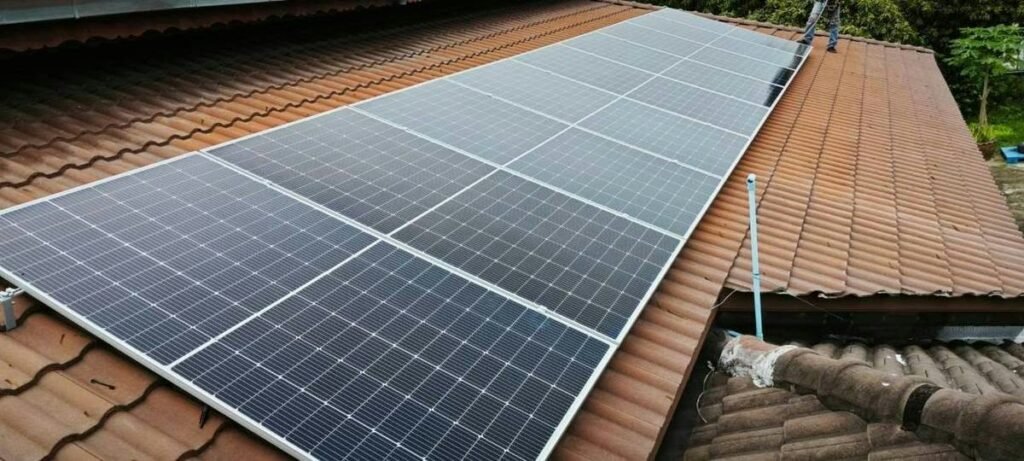
Equipment models and installation scope are confirmed in your quotation.
START HERE
How a rooftop solar system works.
1 / SUNLIGHT
Panels generate DC
Photovoltaic modules convert daylight into direct-current electricity. Weather and shading affect output; night-time generation is not available.
2 / CONVERSION
The inverter supplies AC
The inverter converts the electricity for your property and manages the connection according to its capabilities and the agreed system design.
3 / USE & STORE
Your loads use the energy
Daytime demand can use solar directly. Excess may be stored in a compatible battery or handled according to the authorised grid arrangement.
Use this solar energy guide for Thailand to compare your options.
DAYTIME GENERATION
On-grid
Connected to the utility supply. A simpler option for daytime savings; an ordinary system shuts down during a grid outage.
SOLAR + STORAGE
Hybrid
Combines solar, a compatible battery and grid connection. Backup requires the correct inverter capability, isolation and selected circuits.
INDEPENDENT DESIGN
Off-grid
Designed to operate independently from the utility. Requires careful load, generation, battery and often backup-generator planning. Ask for a tailored assessment.
Understand systems, installation and ongoing care.
Will solar work during a power cut?
An ordinary on-grid system disconnects when the grid fails. Backup needs a compatible hybrid inverter, battery, safe isolation/changeover arrangement and agreed essential circuits. Adding a battery does not automatically mean every appliance is backed up.
Do I need a battery?
Not always. If you use most electricity in the day, on-grid solar may offer a simpler starting point. Storage can be useful when you have surplus daytime generation and evening demand, or when you want a designed backup capability. Compare the extra cost with your priorities.
What does single-phase or three-phase mean?
It describes your electrical supply, not a quality tier. Both supply types can use on-grid or hybrid systems. Your bill, meter and electrical survey help us select compatible equipment.
Can I sell unused solar electricity?
Export arrangements depend on your electricity authority, applicable programme, eligibility and approvals. Export is not automatically paid at your retail tariff. Our calculator gives unused or exported electricity no income.
How much roof space do I need?
The calculator allows about 5 m² per kWp as a planning assumption. A survey checks the actual panel dimensions, usable area, clearances, shading, roof condition and mounting requirements.
What is included in the quote?
Your written quotation should identify equipment models, array size, electrical compatibility, installation and commissioning work, any approval support, exclusions, tax treatment and the total price. Confirm whether surveys, applications, monitoring setup and after-sales services are included. Authority approval is subject to the applicable requirements.
Will panels work on cloudy days?
They can still generate electricity when light reaches the modules, but output is lower than in strong sunshine. Rain, cloud, shading, temperature and orientation affect production. A proposal should explain its annual-generation assumptions.
Is the starting price my final installation price?
The PSI package prices shown on this site come from the supplied offers. The final total depends on the property, equipment, electrical work and agreed installation scope. Ask for a written quotation confirming the current price, tax treatment, inclusions and any additional works before deciding.
How should I look after the system?
Use monitoring to check generation and investigate persistent changes. Arrange inspections and cleaning appropriate to your roof, local conditions and manufacturer guidance. Leave roof access and electrical checks to appropriately qualified people.
CHECK THE CURRENT REQUIREMENTS
Where to verify the details.
Start with the question you’re trying to answer. Are you looking to cut daytime electricity costs, use stored energy after dark or keep a few essentials running during a power cut? Those are different jobs, and they can lead to different systems.
A recent bill shows how much energy you buy, but when you use it matters too. An on-grid system often makes most sense when you can use its output during daylight. A battery can move some energy to the evening, though it adds cost and has its own limits.
Understand power and energy
Also, keep kW and kWh separate. kW describes power at a moment; kWh describes energy over time. For example, a steady 0.5 kW load running for four hours uses 2 kWh before losses. That’s an illustration, not a battery-sizing recommendation.
A roof survey, equipment specifications and a written quote are the next steps. Check any generation or savings estimate against its assumptions. Tariffs, export programmes and connection rules can change, so confirm the conditions that apply to your electricity account.
For more detail, read the on-grid and hybrid comparison, our battery guide or the warranty checklist.
Technical background: US Department of Energy: inverters and grid services. For solar resource data: Global Solar Atlas.
YOUR NEXT STEP
Ready to find out whether solar makes sense for you?
Send us a recent bill and tell us where the building is. We’ll talk through the options, confirm coverage and explain the next step. There’s no obligation to buy.